In the dynamic landscape of Indian taxation, the Goods and Services Tax (GST) introduced a revolutionary mechanism designed to eliminate the cascading effect of taxes. At the heart of this mechanism lies the concept of input tax credit GST. For businesses, understanding ITC is akin to managing the lifeline of their working capital. It is not merely a tax benefit; it is a fundamental right of a registered taxpayer, provided specific conditions are met.
However, claiming this credit isn’t as simple as filing a return. The rules governing input tax credit GST have evolved significantly, becoming more stringent to curb tax evasion. Whether you are a startup founder or a seasoned CFO, navigating these rules is essential to ensure compliance and avoid costly litigation. In this comprehensive guide, we will dissect the critical rules, documentation requirements, and common pitfalls associated with claiming ITC.
What is Input Tax Credit GST and Why Does It Matter?
To put it simply, input tax credit GST is the tax you pay on purchases (inputs) which you can subtract from the tax you are liable to pay on your sales (outputs). This mechanism ensures that tax is levied only on the value addition at each stage of the supply chain.
For instance, if a manufacturer purchases raw materials worth ₹1,00,000 attracting a GST of ₹18,000, and sells the finished product for ₹1,50,000 attracting a GST of ₹27,000, they don’t pay the full ₹27,000 to the government. Instead, they utilize the input tax credit GST of ₹18,000 and pay only the balance of ₹9,000 in cash. This direct reduction in cash outflow makes ITC a pivotal component of cash flow and tax planning strategies for any business.
Core Eligibility Conditions to Claim Input Tax Credit GST
Section 16 of the CGST Act lays down the foundation for claiming ITC. You cannot simply claim credit based on estimates; the law requires strict adherence to four primary conditions. If any of these are missing, your claim for input tax credit GST can be denied, leading to interest and penalties.
1. Possession of Tax Invoice
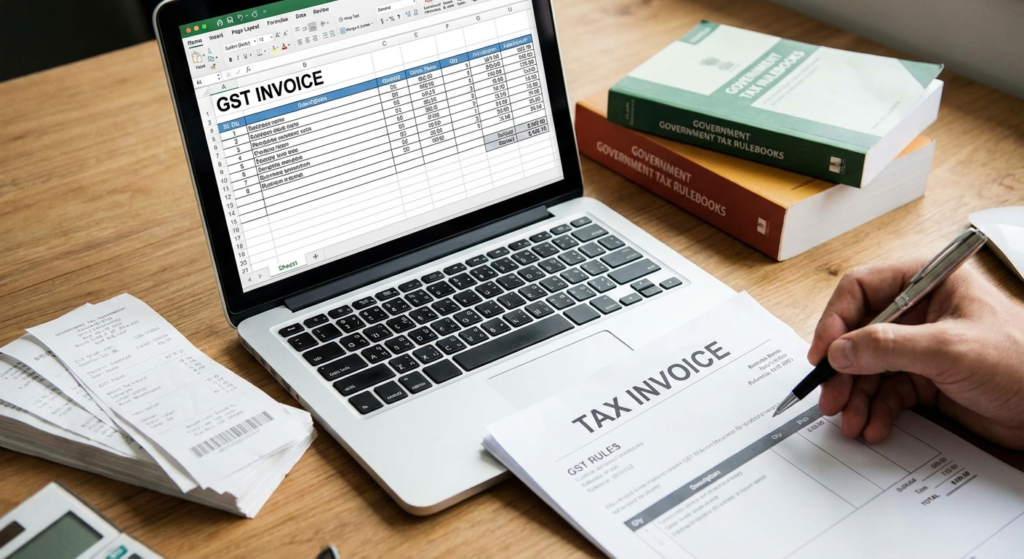
You must hold a valid tax invoice or debit note issued by a registered supplier. This document is the primary evidence required to validate your claim.
2. Receipt of Goods/Services
You must have actually received the goods or services. In “Bill to Ship to” models, the goods are deemed to be received when delivered to the third party.
3. Tax Paid to Government
The supplier must have actually paid the tax charged to the government, either in cash or through their own ITC utilization.
4. Filing of Returns
You must have filed your GST returns (GSTR-3B). Without filing the return, the credit cannot be legally credited to your electronic credit ledger.
Documentation and GSTR-2B Reconciliation
In the early days of GST, businesses often claimed ITC based on their purchase registers. Today, the rules for input tax credit GST have tightened. A crucial condition added recently is that the ITC you claim must appear in your GSTR-2B statement.
Your GSTR-2B is a static statement generated based on the GSTR-1 filed by your suppliers. If your supplier fails to file their return or files it incorrectly, the input tax credit GST will not reflect in your GSTR-2B, and consequently, you cannot claim it in your GSTR-3B. This makes vendor compliance management as critical as your own e-filing of income tax and GST returns.
Reversal of Input Tax Credit GST (The 180-Day Rule)
A lesser-known but vital rule regarding input tax credit GST is the 180-day condition. According to the second proviso to Section 16(2), if a recipient fails to pay the supplier the value of the supply along with the tax within 180 days from the date of invoice, the ITC availed must be reversed.
This reversal must be done along with interest. However, once the payment is finally made to the supplier, the recipient can re-avail the credit. This rule ensures that the ecosystem remains clean and payments flow through the supply chain efficiently.
Blocked Credits: When You Cannot Claim Input Tax Credit GST
Not all GST paid on purchases is eligible for credit. Section 17(5) of the CGST Act defines “Blocked Credits” or ineligible ITC. Even if you use these goods for business, the law prohibits claiming input tax credit GST on them.
- Motor Vehicles: Generally, ITC is blocked for passenger vehicles with a seating capacity of 13 or less, unless you are in the business of transporting passengers or driving training.
- Food and Beverages: Expenses on office parties, catering, or employee meals are generally blocked unless required by a specific law (statutory obligation).
- Construction of Immovable Property: GST paid on materials or services for constructing an office building (for self-use) is blocked.
- Personal Use: Any goods or services used for personal consumption by directors or employees are ineligible.
Capital Goods and Input Tax Credit GST
When you purchase capital goods (machinery, computers, etc.), you can claim input tax credit GST. However, there is a catch. If you claim depreciation on the tax component of the capital goods under the Income Tax Act, you cannot claim ITC. You must choose between claiming depreciation on the tax portion or claiming the ITC.
Furthermore, if you sell the capital asset later, you must pay an amount equal to the ITC reduced by percentage points (5% per quarter) or the tax on the transaction value, whichever is higher. This ensures that the input tax credit GST benefit corresponds to the asset’s usage life.
Time Limits for Availing Input Tax Credit GST
You cannot claim old credits indefinitely. The government has set a specific deadline for availing input tax credit GST for a particular financial year. As per the latest amendments, the deadline is the 30th of November following the end of the financial year, or the date of filing the relevant Annual Return, whichever is earlier.
For example, for invoices dated between April 2023 and March 2024 (FY 2023-24), the last date to claim any missed ITC is typically November 30, 2024. Missing this deadline usually results in a permanent loss of the credit, directly impacting your profit margins.
Expert Insight
“Effective reconciliation is not a year-end activity; it is a monthly necessity. Businesses that automate the matching of their Purchase Register with GSTR-2B save an average of 15% more on valid tax credits compared to those relying on manual checks.”
Conclusion
Navigating the labyrinth of input tax credit GST rules requires vigilance and discipline. From ensuring your suppliers file their returns to tracking the 180-day payment rule, the compliance burden is significant. However, the reward is a seamless flow of credit that protects your working capital and ensures you only pay tax on value addition.
Remember, the authorities are using advanced data analytics to match inputs and outputs. Any discrepancy can trigger automated notices. Therefore, maintaining robust documentation and conducting regular internal audits is the best defense. By mastering these rules, you turn a compliance obligation into a strategic financial advantage.
For more detailed statutory provisions, you can refer to the Central Board of Indirect Taxes and Customs (CBIC) or check your compliance status on the GST Common Portal.
FAQs
Yes, you can claim ITC on hotel accommodation if it is for business purposes. However, the hotel must be located in the same state where your business is registered to pass on the credit (CGST+SGST). If the hotel is in a different state, they will charge IGST or CGST+SGST of that state, which might restrict your claim depending on the Place of Supply rules.
If your supplier does not file GSTR-1, the invoice will not appear in your GSTR-2B. Under current rules, you are restricted from claiming input tax credit GST on invoices that are not reflected in GSTR-2B. You should follow up with the vendor to ensure compliance.
Generally, no. Section 17(5) blocks ITC on motor vehicles for the transportation of persons having a seating capacity of not more than 13 persons, unless you are in the business of selling cars or transporting passengers.
Possession of a valid tax invoice is a mandatory condition under Section 16. If you have lost the physical copy, you should try to obtain a duplicate copy from the supplier. A digital copy (e-invoice) is also valid proof for claiming credit.
You can claim missed ITC for a financial year up to the 30th of November of the following financial year, or the date of filing the Annual Return, whichever is earlier.
Read Also:
- 10 Essential Rules of GST for E-Commerce Sellers: The Ultimate Compliance Guide
- GST on Restaurant Food in 2026: The Ultimate 5-Minute Guide
- ROC Filing Due Dates 2026: The Ultimate Compliance Calendar – Visual Story
- Form DRC 03: The Ultimate Guide to Voluntary GST Payments (2026)