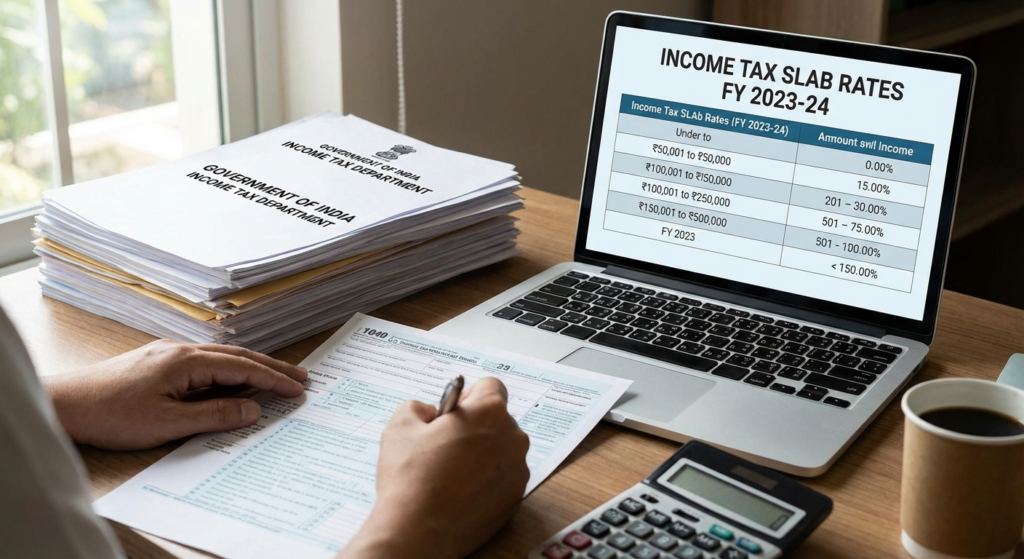
Navigating the complex world of taxation can often feel like walking through a maze without a map. Whether you are a salaried employee, a freelancer, or a business owner, understanding the income tax slab rates India is fundamental to financial planning. With the recent updates in the Union Budget, the government has pushed for a more streamlined tax structure, yet the existence of two distinct regimes continues to spark debate among taxpayers.
In this comprehensive guide, we will break down everything you need to know about the income tax slab rates India for the Financial Year 2024-25 (Assessment Year 2025-26). We will compare the Old and New Regimes, explore exemptions, and provide actionable insights to help you choose the path that saves you the most money. Let’s dive into the details and decode your tax liability.
Understanding the New Income Tax Slab Rates India for FY 2024-25
The Government of India has been actively promoting the New Tax Regime as the default option for taxpayers. The primary allure of this regime is the significantly lower tax rates compared to the traditional structure. However, it comes with a trade-off: you must forego most of the popular deductions and exemptions (like HRA and Section 80C).
The latest budget has further sweetened the deal by tweaking the slabs. Understanding the nuances of the new income tax slab rates India is crucial for anyone looking to optimize their take-home pay. The structure is designed to be progressive, meaning higher income earners pay a higher percentage, but the entry-level relief has been widened.
Under the New Regime, the rebate limit under Section 87A has been increased, meaning income up to ₹7 Lakhs is effectively tax-free. This is a massive relief for entry-level professionals and small business owners.
Up to ₹3,000,000
Tax Rate: Nil
No tax is applicable for income falling within this bracket.
₹3,00,001 to ₹7,00,000
Tax Rate: 5%
Tax applies only on the amount exceeding ₹3 Lakhs (Subject to 87A rebate).
₹7,00,001 to ₹10,00,000
Tax Rate: 10%
A moderate rate applied to the middle-income segment.
₹10,00,001 to ₹12,00,000
Tax Rate: 15%
Significant jump in rate for the upper-middle bracket.
₹12,00,001 to ₹15,00,000
Tax Rate: 20%
Tax liability increases as you approach the high-income threshold.
Above ₹15,00,000
Tax Rate: 30%
The highest slab rate applicable to top earners.
Key Features of the New Regime Income Tax Slab Rates India
The New Regime is simplified and aims to reduce paperwork. You do not need to collect investment proofs or worry about submission deadlines for most deductions. It is particularly beneficial for individuals who do not have significant investments in instruments like PPF, LIC, or home loans.
However, it is important to note that the Standard Deduction of ₹50,000 (which was previously exclusive to the Old Regime) has now been introduced to the New Regime as well, making the income tax slab rates India under this option even more attractive for salaried personnel.
Old Regime Income Tax Slab Rates India: Is It Still Beneficial?
Despite the push for the New Regime, the Old Tax Regime remains a favorite for many, especially those who have committed to long-term financial planning involving tax-saving instruments. The Old Regime income tax slab rates India are higher at face value, but the effective tax can be lower if you utilize the plethora of deductions available.
If you are paying a home loan, contributing to the National Pension System (NPS), or paying high premiums for health insurance, the Old Regime might still be your best bet. It allows you to reduce your taxable income significantly before the tax rates are applied.
- Up to ₹2.5 Lakhs: Nil Tax
- ₹2.5 Lakhs to ₹5 Lakhs: 5%
- ₹5 Lakhs to ₹10 Lakhs: 20%
- Above ₹10 Lakhs: 30%
As you can see, the jump from 5% directly to 20% is steep compared to the gradual increase in the New Regime. This is why high exemptions are necessary to make this regime viable.
Comparing Income Tax Slab Rates India: Old vs. New Regime
The choice between the two regimes is not always straightforward. It depends entirely on your financial behavior and investment portfolio. To make an informed decision regarding the income tax slab rates India, you must calculate your total eligible deductions.
Experts generally suggest a “Breakeven Point” analysis. If your total deductions (including Section 80C, 80D, HRA, LTA, and Standard Deduction) exceed ₹3.75 Lakhs, the Old Regime usually results in lower tax liability. If your deductions are below this threshold, the New Regime is likely more beneficial.
For business owners, the situation can be slightly different. While salaried individuals can switch between regimes every year, those with business income have limited flexibility in switching back and forth. If you are a business owner considering winding up operations, understanding the tax implications is vital. You might want to read about the process in our guide on how to close a private limited company in India to ensure you settle all tax dues correctly.
Impact of Surcharges on Income Tax Slab Rates India
For High Net-worth Individuals (HNIs), the surcharge rates play a massive role in the final tax outflow. A surcharge is an additional tax levied on the tax payable. Under the New Regime, the highest surcharge rate has been reduced from 37% to 25% for income exceeding ₹5 Crores. This reduction significantly lowers the effective tax rate for the super-rich.
This change in surcharge makes the New Regime income tax slab rates India highly lucrative for those in the highest income brackets, as the effective tax rate drops by several percentage points.
Income > ₹50 Lakhs
Surcharge: 10%
Applicable on the tax amount, not the income.
Income > ₹1 Crore
Surcharge: 15%
Marginal relief is available in certain cases.
Income > ₹2 Crores
Surcharge: 25%
Applicable under both regimes (capped at 25% for New Regime).
Senior and Super Senior Citizen Income Tax Slab Rates India
The government provides relaxation for our elders. However, it is important to note that the distinct slab benefits for Senior Citizens (60-80 years) and Super Senior Citizens (80+ years) are primarily available under the Old Tax Regime. Under the New Regime, the basic exemption limit is ₹3 Lakhs for everyone, regardless of age.
Under the Old Regime:
- Senior Citizens (60-80 years): Exemption limit is ₹3 Lakhs.
- Super Senior Citizens (80+ years): Exemption limit is ₹5 Lakhs.
This differentiation is a critical factor for retirees whose income comes from pensions and interest. If you fall into this category, calculating your liability based on the specific income tax slab rates India for seniors is essential to avoid overpaying.
Strategic Tax Planning for 2025
Tax planning should not be a last-minute activity done in March. It requires a holistic view of your finances throughout the year. With the digitization of the economy, compliance has become stricter. For instance, recent updates from the GST Council 54th meeting highlights indicate a tighter integration between GST and Income Tax data. This means discrepancies between your declared turnover in GST and income in ITR can trigger notices.
Here are some strategic steps to optimize your taxes:
- Evaluate Your Deductions: List every possible deduction you are eligible for (HRA, 80C, 80D, Education Loan interest).
- Run the Comparison: Use an online income tax calculator to compare liabilities under both regimes.
- Check for Allowances: Ensure your salary structure is optimized. Allowances like food coupons or uniform allowance are tax-exempt under the Old Regime.
- Stay Compliant: Ensure all your high-value transactions are reported correctly, as the Income Tax Department uses AI to track expenditures.
For more detailed information on fiscal policies, you can also refer to the Ministry of Finance website.
Conclusion
Understanding the income tax slab rates India is the first step toward financial freedom. While the New Regime offers simplicity and lower rates for those with fewer deductions, the Old Regime remains a fortress for those heavily invested in tax-saving instruments. The landscape of taxation in India is evolving to become more taxpayer-friendly, but the onus remains on the individual to select the most beneficial path.
Remember, tax saved is income earned. By carefully analyzing the income tax slab rates India for the current assessment year and aligning them with your financial goals, you can ensure that you are not paying a penny more than required. Stay informed, plan early, and file your taxes on time to enjoy a stress-free financial year.
FAQs
The basic exemption limit under the New Tax Regime has been increased to ₹3 Lakhs. Furthermore, a tax rebate under Section 87A makes income up to ₹7 Lakhs effectively tax-free.
Salaried individuals and pensioners can choose between the Old and New Regimes every year based on which is more beneficial. However, individuals with business or professional income can only switch once in their lifetime; once they opt for the New Regime, they cannot easily go back to the Old Regime.
Yes, starting from FY 2023-24, the Standard Deduction of ₹50,000, which was previously available only under the Old Regime, has been extended to the New Tax Regime for salaried employees.
If you have deductions (like 80C, 80D, HRA) exceeding ₹2.5 Lakhs to ₹3 Lakhs, the Old Regime might be better. If you do not have significant investments or HRA, the New Regime will likely result in a lower tax liability due to lower slab rates.
No, the New Tax Regime has a uniform basic exemption limit of ₹3 Lakhs for all individuals, regardless of age. The higher exemption limits for Senior Citizens (₹3 Lakhs) and Super Senior Citizens (₹5 Lakhs) are only applicable under the Old Tax Regime.
Read Also:
- 7 Essential Steps for Income Tax Return Filing India: The Complete 2025 Guide
- Freelancer Income Tax India: 9 Essential Steps to Save Money (2025 Guide)
- 7 Essential Rules of NRI Taxation India: The 2024 Comprehensive Guide
- MGT-7 Filing 2026: Your Essential Guide
- Unlock Your 2026 Small Company Benefits
- TDS Rates FY 2020-21: The Definitive 2026 Guide for Old Returns
- Proprietorship Firm Registration in 2026: A 5-Minute Guide – Visual Story
- Unlock Your 2026 Tax Notice Fast