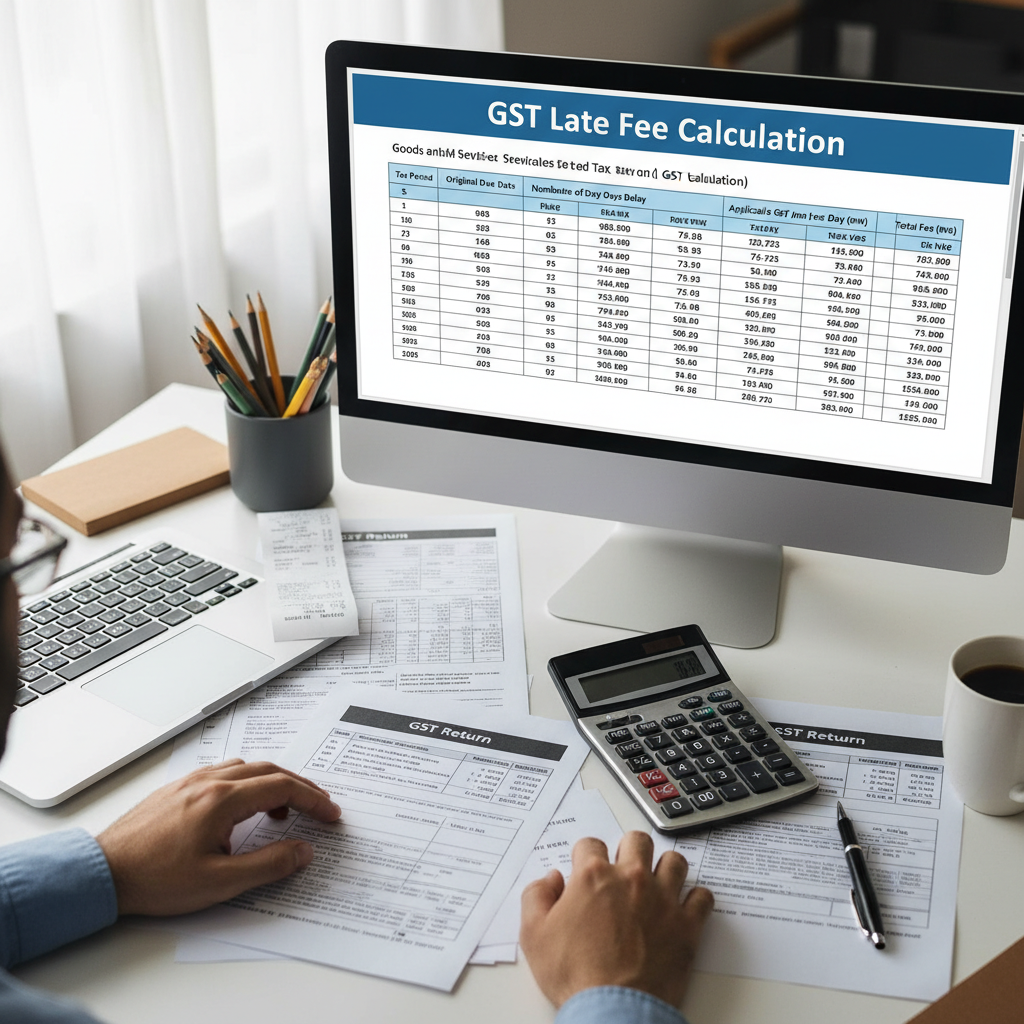
Introduction: The Criticality of Timely GST Compliance
The Goods and Services Tax (GST) regime in India operates on strict deadlines. Failing to file mandatory GST returns, such as GSTR-3B or GSTR-1, by the due date results in penalties that can significantly impact a business’s cash flow. These penalties are levied in two primary forms: interest and the GST late fee calculation. While interest applies to the outstanding tax liability, the late fee is a statutory charge imposed purely for the delay in filing the return itself.
Understanding the exact mechanism of the GST late fee calculation is crucial for every registered taxpayer. This comprehensive guide breaks down the statutory provisions, daily rates, maximum caps, and recent governmental changes, ensuring you are equipped to manage your compliance obligations effectively.
Understanding the Basics of the GST Late Fee System
A late fee is levied under Section 47 of the CGST Act, 2017. Unlike interest, which is calculated at 18% per annum on the net tax liability, the late fee is a fixed daily charge that accumulates until the return is finally filed. This fee serves as a deterrent against non-compliance and ensures the timely flow of information into the government’s tax system.
Key Returns Subject to GST Late Fee Calculation
The late fee primarily applies to the following returns:
- GSTR-3B: The summary return for outward and inward supplies and payment of tax. This is the most common return subject to the late fee.
- GSTR-1: The statement of outward supplies.
- GSTR-9: The annual return filed by regular taxpayers.
- GSTR-4: The quarterly return for composite scheme taxpayers.
It is important to note that the late fee is calculated on a per-return, per-day basis from the day immediately following the due date until the actual filing date. The government periodically introduces amnesty schemes to provide relief, making it essential to stay updated on current circulars and notifications.
Detailed GST Late Fee Calculation for GSTR-3B and GSTR-1
The methodology for the GST late fee calculation differs based on whether the taxpayer has a tax liability (tax payable) or a Nil return (no tax payable). The calculation mechanism has been simplified over time, but the statutory caps are the most critical element to track.
Daily Rates and Statutory Caps on GST Late Fee Calculation
As per the current provisions and various relief notifications, the daily late fee is set, but it is capped based on the turnover and the nature of the tax liability. The standard daily rate is Rs. 100 under the CGST Act and Rs. 100 under the SGST Act, totaling Rs. 200 per day (Rs. 100 CGST + Rs. 100 SGST). However, the applicable maximum limit is usually much lower.
The calculation is generally summarized as:
Late Fee = (Rs. 100 CGST + Rs. 100 SGST) * Number of Days Delayed, capped at a prescribed maximum amount.
Case 1: Nil Return (Zero Tax Liability)
If the GSTR-3B or GSTR-1 return shows zero tax liability, the maximum late fee is significantly lower.
- Daily Rate: Rs. 10 (CGST) + Rs. 10 (SGST) = Rs. 20 per day.
- Maximum Cap: Rs. 500 (Rs. 250 CGST + Rs. 250 SGST) per return.
Case 2: Tax Liability Present (Non-Nil Return)
If the taxpayer has any amount of tax payable for the period, the standard daily rate applies, subject to the turnover-based caps.
- Daily Rate: Rs. 100 (CGST) + Rs. 100 (SGST) = Rs. 200 per day.
- Maximum Cap: Varies based on Annual Aggregate Turnover (AATO).
Maximum Caps Based on Annual Aggregate Turnover (AATO)
The government introduced differentiated caps based on the business size to provide relief to small and medium enterprises (SMEs).
AATO up to Rs. 1.5 Crore
For taxpayers whose AATO in the preceding financial year was up to Rs. 1.5 Crore, the maximum late fee cap for GSTR-3B is Rs. 2,000 (Rs. 1,000 CGST + Rs. 1,000 SGST).
AATO between Rs. 1.5 Cr and Rs. 5 Crore
For businesses with an AATO between Rs. 1.5 Crore and Rs. 5 Crore, the maximum late fee cap for GSTR-3B is Rs. 5,000 (Rs. 2,500 CGST + Rs. 2,500 SGST).
AATO Exceeding Rs. 5 Crore
For large taxpayers whose AATO exceeds Rs. 5 Crore, the maximum late fee cap for GSTR-3B is Rs. 10,000 (Rs. 5,000 CGST + Rs. 5,000 SGST).
It is crucial to remember that these caps apply independently to GSTR-3B and GSTR-1. If both returns are delayed, the total liability could be twice the respective caps.
Practical Example: Calculating the GST Late Fee
Let’s consider a practical scenario to illustrate the GST late fee calculation:
- Taxpayer: Alpha Traders, AATO is Rs. 4 Crore.
- Return Due Date: 20th of the month (e.g., May 20th).
- Actual Filing Date: June 15th.
- Delay Period: 26 days (from May 21st to June 15th).
- Tax Liability: Rs. 50,000 (Taxable Return).
Calculation Steps:
- Daily Fee Rate: Rs. 200 per day.
- Total Calculated Fee: 26 days * Rs. 200 = Rs. 5,200.
- Applicable Cap (AATO Rs. 1.5 Cr to Rs. 5 Cr): Rs. 5,000.
Result: Since the calculated fee (Rs. 5,200) exceeds the statutory cap (Rs. 5,000), Alpha Traders will only be charged the maximum late fee of Rs. 5,000.
The Special Case of GSTR-9 (Annual Return) Late Fee
The annual return (GSTR-9) has a separate late fee structure, which is often much stricter due to the comprehensive nature of the return. The due date for GSTR-9 is typically December 31st following the end of the financial year.
The late fee for delayed GSTR-9 filing is Rs. 100 per day under CGST and Rs. 100 per day under SGST, totaling Rs. 200 per day. This fee is subject to a maximum cap of 0.5% of the turnover in the State or Union Territory (0.25% CGST + 0.25% SGST).
“Compliance is not just about paying tax; it’s about providing information accurately and promptly. The late fee structure reflects the government’s emphasis on timely data submission for seamless tax administration.”
Impact of Amnesty Schemes on GST Late Fee Calculation
Tax authorities periodically announce amnesty schemes, particularly after major disruptions or during the cleanup of pending returns. These schemes temporarily reduce or waive the late fee for specific periods and specific returns (usually GSTR-3B). For instance, an amnesty scheme might reduce the maximum late fee for pending returns of a certain period to Rs. 500, regardless of the tax liability.
Taxpayers with historical pending returns should always monitor official announcements on the official GST portal to take advantage of these limited-time relief measures.
Distinguishing Late Fee from Interest Penalty
A common source of confusion is the difference between the late fee and the interest penalty. While both are consequences of delayed compliance, they target different aspects of the delay.
Late Fee (Section 47)
- Purpose: Penalty for delay in filing the return document itself.
- Basis: Fixed daily rate (usually Rs. 200), subject to statutory caps based on AATO.
- Applicability: Applies even if tax liability is Nil (though capped lower).
- Payment: Must be paid before filing the delayed return.
Interest (Section 50)
- Purpose: Compensation for delayed payment of tax revenue to the government.
- Basis: Calculated at 18% per annum (or 24% for wrong Input Tax Credit utilization) on the outstanding tax amount.
- Applicability: Only applies if there is a positive tax liability.
- Payment: Paid through the electronic cash ledger (DRC-03).
If you delay filing GSTR-3B for a month and had a tax liability, you will be liable for both the late fee (capped amount) and the interest (18% on the tax due for 30 days).
Actionable Strategies for Minimizing and Avoiding GST Late Fee
The simplest way to avoid the late fee is timely compliance. However, even with the best intentions, businesses sometimes face operational hurdles. Here are actionable strategies:
- Prioritize GSTR-3B Filing: Even if you are unable to pay the full tax liability immediately, filing GSTR-3B on time prevents the accumulation of the late fee. Interest will still apply to the unpaid amount, but the daily late fee of Rs. 200 will be avoided.
- Utilize the Nil Return Cap: If you genuinely have no business transactions or tax liability for a period, ensure you file a Nil return promptly to benefit from the extremely low late fee cap (Rs. 500 maximum) if delayed.
- Automate Compliance Checks: Use accounting software or professional services to set up automatic reminders well ahead of the due date. Consistent and timely GST Return Filing is the backbone of healthy compliance.
- Maintain Accurate AATO Records: Your Annual Aggregate Turnover (AATO) dictates the maximum cap applicable to you. Ensure this figure is correctly determined and referenced when filing to avoid overpayment of fees.
For complex matters related to turnover calculation or historical pending returns, consulting a tax professional is advisable. Navigating the rules, especially those concerning amnesty schemes and exemptions, requires detailed knowledge of the notifications issued by the Central Board of Indirect Taxes and Customs (CBIC). You can often find detailed regulatory circulars on the CBIC official website.
Businesses that maintain detailed records for tax purposes, such as those related to ITR documents, usually find it easier to comply with GST deadlines as the underlying financial data is readily available.
Conclusion: Mastering the Cost of Non-Compliance
The framework for GST late fee calculation is designed to be progressive, imposing lower penalties on smaller taxpayers, especially those filing Nil returns. However, the daily accrual rate of Rs. 200 means that even a short delay can quickly trigger the maximum penalty cap, particularly for larger entities. By understanding your AATO, prioritizing the timely filing of GSTR-3B, and keeping abreast of government notifications regarding amnesty schemes, you can effectively manage compliance risk and avoid unnecessary financial burdens. Proactive compliance is always cheaper than retrospective damage control.
FAQs
For a Nil GSTR-3B return (where there is no tax liability), the GST late fee calculation is capped at Rs. 500 (Rs. 250 CGST + Rs. 250 SGST) per return, with a daily rate of Rs. 20 per day (Rs. 10 CGST + Rs. 10 SGST).
Yes, the late fee is applied separately for each delayed return. If both GSTR-3B and GSTR-1 are filed late for the same tax period, you must pay the applicable late fee for GSTR-3B and the applicable late fee for GSTR-1, subject to their individual caps.
If your AATO exceeds Rs. 5 Crore, the maximum GST late fee calculation cap for a delayed GSTR-3B (with tax liability) is Rs. 10,000 (Rs. 5,000 CGST + Rs. 5,000 SGST).
The late fee is automatically calculated and displayed on the GST portal when you attempt to file the delayed return. It must be paid through the electronic cash ledger (ECL) before the system allows you to submit the return. Interest is generally paid separately using Form DRC-03 after the return is filed, though it can sometimes be adjusted automatically during GSTR-3B payment.
Yes, the late fee applies to GSTR-4 filed by taxpayers under the Composition Scheme. Currently, the late fee is Rs. 50 per day (Rs. 25 CGST + Rs. 25 SGST), capped at Rs. 2,000 (Rs. 1,000 CGST + Rs. 1,000 SGST) per return.