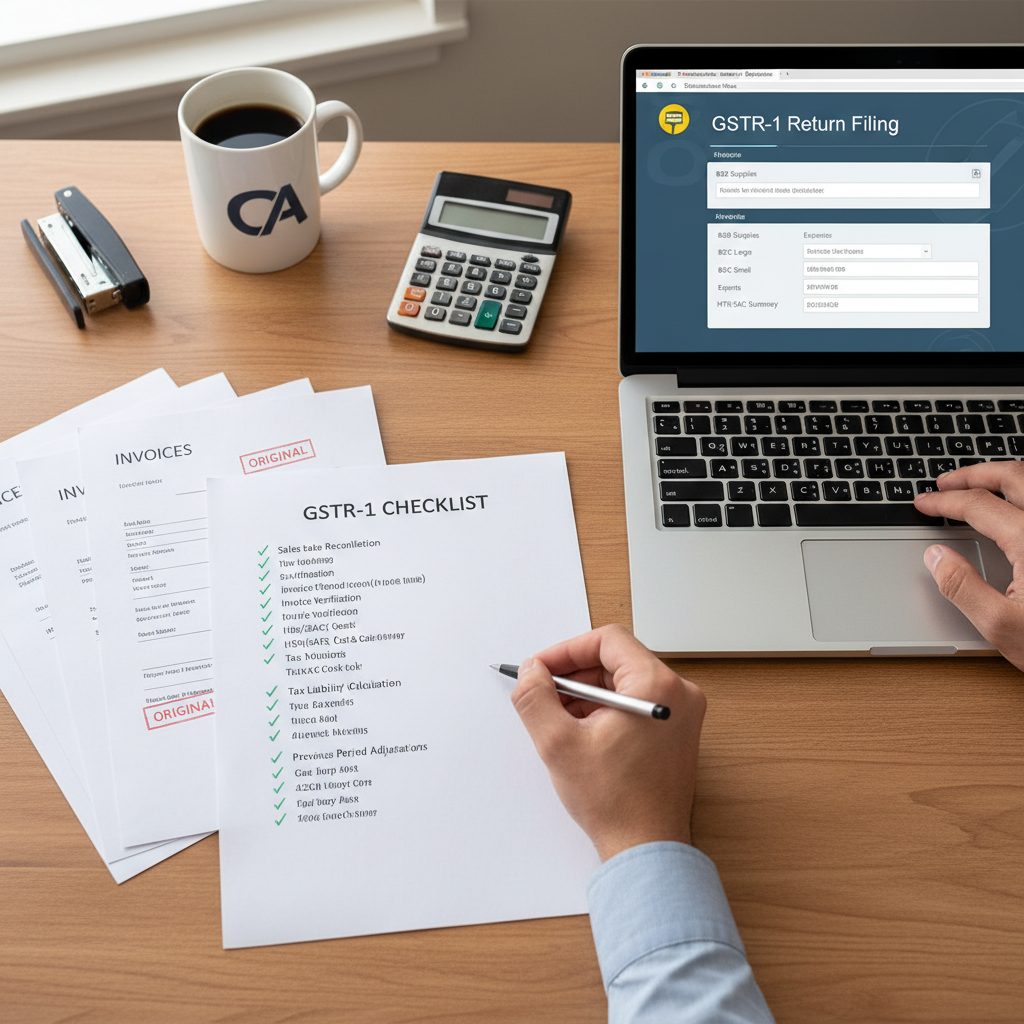
Mastering GSTR-1 Filing: Why a Dedicated GSTR-1 Filing Checklist is Non-Negotiable
For every business registered under the Goods and Services Tax (GST) regime in India, GSTR-1 is arguably the most critical monthly or quarterly return. It serves as the official declaration of all outward supplies (sales) of goods and services made during the reporting period. Accuracy in GSTR-1 is paramount, not just for your compliance score, but because it directly impacts the Input Tax Credit (ITC) available to your buyers.
In the complex world of GST regulations, relying solely on memory or scattered spreadsheets is a recipe for errors, leading to potential penalties or discrepancies with GSTR-3B. To ensure seamless compliance, every registered taxpayer needs a robust, systematic approach. This is where a detailed GSTR-1 filing checklist becomes indispensable. By following this guide, you will master the preparation, validation, and submission process, ensuring your data aligns perfectly with the statutory requirements.
Understanding GSTR-1: The Foundation of Invoice Reporting
GSTR-1 is fundamentally an invoice-level detail report. Unlike GSTR-3B, which summarizes tax liabilities, GSTR-1 provides granular data on every single transaction, categorizing supplies based on the recipient type (B2B, B2C), location (Inter-State or Intra-State), and tax treatment (Taxable, Exempt, Nil-rated).
The information reported in GSTR-1 automatically populates the GSTR-2A and GSTR-2B of your recipients, allowing them to claim ITC. This interconnected nature highlights why data integrity is vital.
Who Must Follow the GSTR-1 Filing Checklist?
Generally, all regular registered taxpayers, including those registered under the QRMP (Quarterly Return Monthly Payment) scheme, must file GSTR-1. There are specific exceptions, such as:
- Input Service Distributors (ISD)
- Composition dealers
- Non-Resident Taxable Persons
- Persons liable to deduct TDS or collect TCS
If you are a regular taxpayer, ensuring you have the necessary documentation prepared using the GSTR-1 filing checklist is your primary responsibility.
Crucial Due Dates and Filing Frequency for GSTR-1
The frequency and due date for GSTR-1 depend primarily on your annual aggregate turnover (AATO).
Monthly Filers
AATO: Exceeds Rs. 5 Crore (or opted out of QRMP).
Due Date: The 11th day of the succeeding month.
Example: For transactions in April, the GSTR-1 must be filed by May 11th.
Quarterly Filers (QRMP Scheme)
AATO: Up to Rs. 5 Crore and opted into the QRMP scheme.
Due Date: The 13th day of the month succeeding the quarter.
Example: For the quarter April-June, the GSTR-1 must be filed by July 13th.
Late Filing Impact
Failure to file GSTR-1 on time attracts late fees and interest, though the late fee is often capped based on turnover and tax liability. Consistent failure can lead to GST registration suspension.
Preparing Your Data: The Ultimate GSTR-1 Filing Checklist
The most time-consuming yet critical step is data collation. Before you even log into the GST portal, you must ensure 100% reconciliation of your accounting books with the required GST formats. Use this comprehensive GSTR-1 filing checklist to organize your data efficiently:
- Invoice Reconciliation: Verify that all sales invoices, credit notes, and debit notes issued during the period are accounted for.
- GSTIN Verification: Ensure the GST Identification Numbers (GSTINs) of all B2B customers are correct and active.
- HSN/SAC Code Alignment: Confirm that the Harmonized System of Nomenclature (HSN) or Service Accounting Code (SAC) summary is ready, categorized by turnover thresholds.
- Document Classification: Separate B2B invoices, B2C Large invoices (Inter-State supplies with invoice value > Rs 2.5 Lakh), B2C Others, and Export Invoices.
- Tax Rate Segregation: Verify that transactions are correctly segregated based on the applicable GST rates (5%, 12%, 18%, 28%).
- Advance Receipts and Adjustments: Identify any advances received for future supplies and adjustments made against previous advances.
- E-way Bill Cross-Check: If applicable, cross-reference high-value shipments with generated e-way bills to ensure consistency in reported values and dates.
Key Components of the Invoice Data Submission
GSTR-1 is structured into several tables, each requiring specific details. Understanding these components is essential for accurate compliance.
B2B Transactions (Table 4A, 4B, 4C, 6B, 6C)
Requires recipient GSTIN, invoice number, date, value, place of supply, and tax rate break-up (CGST, SGST, IGST).
B2C Large Transactions (Table 5A)
Applies to inter-state supplies to unregistered persons where the invoice value exceeds Rs. 2.5 Lakh. Requires invoice number, place of supply, and tax rate.
Credit/Debit Notes (Table 9B)
Details of notes issued during the reporting period, linked to the original invoice. Crucial for reducing or increasing tax liability.
Nil-rated, Exempt, and Non-GST Supplies (Table 8)
Total summary values of supplies that do not attract GST, ensuring the total turnover matches accounting records.
“The robustness of the GSTR-1 hinges entirely on the quality and accuracy of the underlying invoice data. A minor error at the invoice level can lead to major reconciliation issues for both the supplier and the recipient.”
Navigating the GST Portal: Step-by-Step GSTR-1 Filing Process
Once your data is compiled using the GSTR-1 filing checklist, the actual filing process on the GST portal is streamlined, especially if you use the Offline Utility Tool for high volumes of invoices.
Offline Utility vs. Online Preparation
For businesses dealing with hundreds or thousands of invoices, uploading data directly online is impractical. The GST Offline Utility allows you to input data into standardized Excel or CSV templates, validate it offline, and generate a JSON file. This JSON file is then uploaded to the portal in one go, significantly reducing data entry time and server load issues.
The Submission Steps:
- Login: Access the official GST portal using your credentials.
- Select Period: Navigate to ‘Services’ -> ‘Returns’ -> ‘Returns Dashboard’ and select the financial year and reporting period.
- Data Entry/Upload: Choose ‘Prepare Online’ or ‘Prepare Offline’. If uploading JSON, the portal will process the file.
- Review and Summary Generation: After data entry, click ‘Generate GSTR-1 Summary’. Wait for the summary to be generated (this may take up to 30 minutes for large data sets).
- Verify HSN Summary: Ensure the HSN/SAC summary (Table 12) accurately reflects the details of goods and services supplied.
- Final Check: Compare the system-generated summary values with your pre-compiled checklist data.
- File Return: Click ‘Submit’. After submission, no modifications are allowed for the period.
- Authentication: File the return using DSC (Digital Signature Certificate) or EVC (Electronic Verification Code).
Successful GSTR-1 submission is the first crucial step in the overall GST Return Filing cycle. Always ensure the data matches what you will eventually report in GSTR-3B.
Common Errors to Avoid When Using the GSTR-1 Filing Checklist
Even with meticulous preparation, certain mistakes commonly trip up taxpayers during GSTR-1 filing. Awareness of these pitfalls is essential for achieving 100% compliance.
Mismatch in Tax Periods
Failing to report an invoice in the month/quarter it was issued. Invoices must be reported based on the date of issue, not the date of payment.
Solution: Strict adherence to accounting cutoff dates verified by the GSTR-1 filing checklist.
Incorrect Place of Supply (POS)
Mistaking Intra-State supplies for Inter-State supplies, leading to incorrect levy of IGST instead of CGST/SGST or vice versa. This is a common error in B2C transactions.
Solution: Always confirm the POS rules defined under the IGST Act, especially for service providers.
Failure to Report Amendments
Ignoring the requirement to report amendments (Table 9/10) for previous period errors. Amendments must be done promptly to ensure the recipient receives accurate ITC.
Solution: Regularly check communication from recipients regarding ITC mismatches and use the amendment tables.
Wrong HSN Summary Reporting
Reporting the HSN summary (Table 12) inaccurately or failing to meet the mandatory reporting requirement based on turnover thresholds (e.g., 4-digit or 6-digit codes).
Solution: Use the GST portal’s search function to verify official HSN codes before summarizing the data.
For complex amendments or issues related to large turnover discrepancies, businesses should consult the official guidelines provided by the Central Board of Indirect Taxes & Customs (CBIC), which can be found on their official website. Adherence to these rules minimizes scrutiny.
Advanced Reporting: Details Beyond B2B Invoices
While B2B sales form the bulk of GSTR-1, several other tables require specific attention. These tables ensure that all types of outward supplies and documentation are captured comprehensively.
Table 6A: Exports
Requires details of exports, including shipping bill number, date, type of export (with or without payment of tax), and corresponding invoice details. Zero-rated supplies must be clearly marked.
Table 7: B2C Others
This covers all B2C sales that are not ‘B2C Large’ transactions. These are summarized state-wise and rate-wise, as individual invoice details are not required.
Table 11: Advances and Adjustments
Reports any tax paid on advances received during the period and subsequent adjustments made when the invoice for that supply is finally issued.
Table 13: Document Summary
A summary of all documents issued during the period, including invoices, credit notes, debit notes, delivery challans, etc. This is a crucial control measure for the auditor.
By meticulously checking off every item on the GSTR-1 filing checklist, particularly focusing on these specialized tables, businesses can ensure that their reporting is both complete and compliant with the detailed requirements of the GST law.
Conclusion: Achieving Error-Free Compliance with the GSTR-1 Filing Checklist
GSTR-1 is more than just a sales report; it is the cornerstone of the GST ecosystem, enabling the seamless flow of Input Tax Credit. Mastering the filing process requires diligence, organization, and a systematic approach.
By implementing a robust GSTR-1 filing checklist, businesses can move away from reactive compliance toward proactive accuracy. Regularly reviewing due dates, ensuring the integrity of invoice data, and utilizing the offline tools provided by the GST portal are key strategies for minimizing penalties and maximizing operational efficiency. Remember, timely and accurate GSTR-1 submission benefits both your business and your customers.
FAQs
GSTR-1 is the statement of outward supplies, providing invoice-level details of sales (both B2B and B2C). GSTR-3B is a summarized return that declares the total tax liability (output tax) and the eligible Input Tax Credit (ITC) for the month, along with the actual tax payment. GSTR-1 data must align with the output tax declared in GSTR-3B.
No, once GSTR-1 is successfully submitted, it cannot be modified for that period. However, any errors or omissions discovered after submission must be rectified in the subsequent month’s GSTR-1 using the amendment tables (Table 9, 10, or 4A, 4B, 4C, 6B, 6C Amendment sections).
If you forget to report a B2B invoice, your recipient will not see that transaction reflected in their GSTR-2A/2B and thus cannot claim the corresponding Input Tax Credit (ITC). You must report the missed invoice in the amendment table of the subsequent GSTR-1 filing period.
The Quarterly Return Monthly Payment (QRMP) Scheme is available for taxpayers with an annual aggregate turnover (AATO) up to Rs. 5 Crore. Under QRMP, taxpayers file GSTR-1 and GSTR-3B quarterly (by the 13th day of the month succeeding the quarter), but they must still pay their taxes monthly via the PMT-06 challan.
Yes, HSN summary reporting (Table 12) is mandatory, but the level of detail required depends on the AATO. Taxpayers with an AATO up to Rs. 5 Crore must report HSN codes at a 4-digit level for B2B supplies, while those exceeding Rs. 5 Crore must report at a 6-digit level for all supplies.
Read Also:
- Maximizing Growth: The Essential Udyam Certificate Benefits List for Indian MSMEs
- The Definitive GSTR-2A Reconciliation Checklist: A Guide to Maximizing Input Tax Credit (ITC)
- Comprehensive Form 27EQ Filing Guide 2024: TCS Return Basics and Due Dates
- Essential GST Registration Documents List: A Comprehensive Checklist for Businesses
- 7 Essential Steps to Master the GST Refund Process India: A Comprehensive Guide (2025)
- 7 Critical Rules for Input Tax Credit GST Every Business Must Master in 2025
- 7 Critical GST Return Due Dates Every Business Owner Must Know (2025 Guide) – Visual Story
- GST on Restaurant Food 2026: The 5% vs 18% Rule Explained
- Director Alert: Your 2026 Survival Guide
- Odisha Scholarship 2026: Your Future Funded
- Unlock Your 2026 Tax Notice Fast