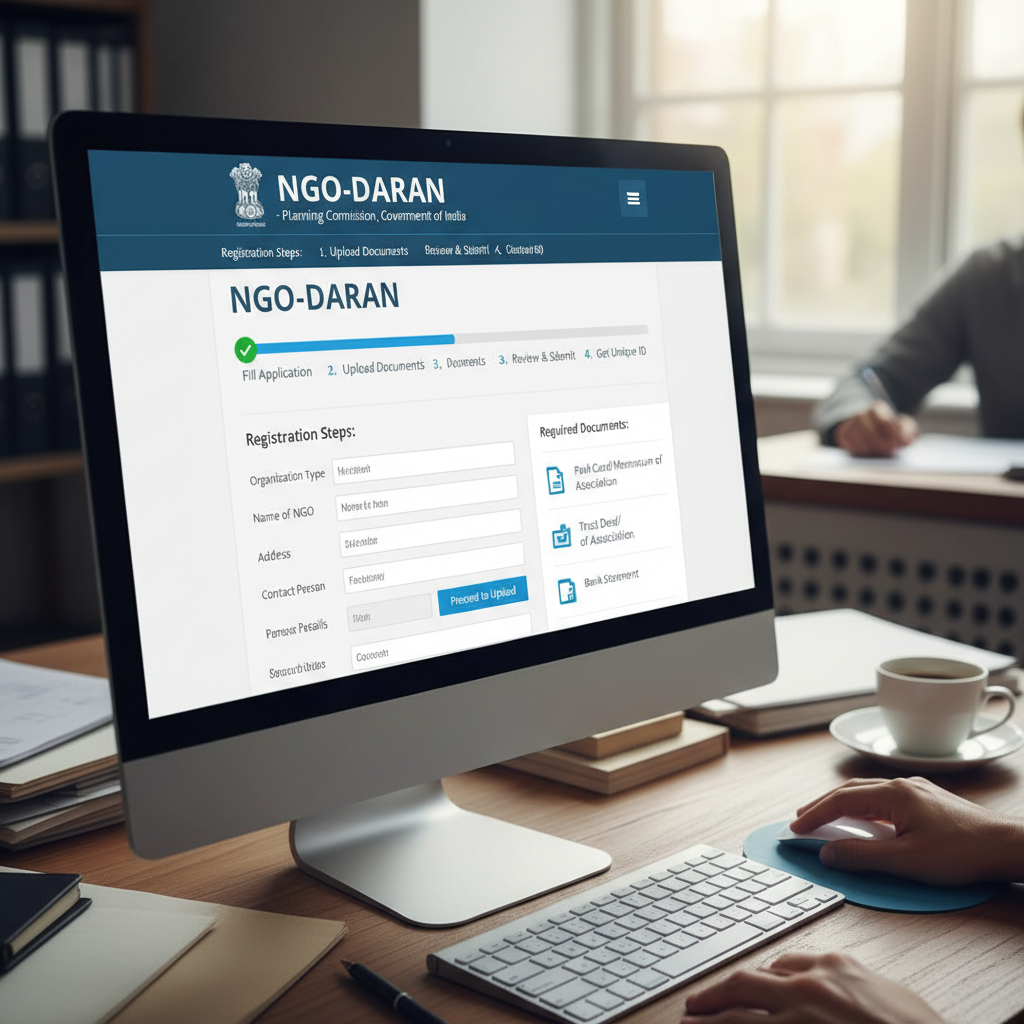
Decoding the NITI Aayog NGO Darpan Portal: Why Registration is Non-Negotiable
In the vibrant ecosystem of non-profit organizations in India, transparency and accountability are paramount. The Government of India, through NITI Aayog (National Institution for Transforming India), established the NGO Darpan portal as a centralized platform for Non-Governmental Organizations (NGOs) and Voluntary Organizations (VOs). This registry serves as the primary interface between the voluntary sector and various government ministries, departments, and bodies.
For any organization aiming to partner with the government, receive grants, or simply build credibility, mastering the complete NGO Darpan registration steps is the essential first step. Within the first 100 words, it is clear that navigating this process successfully unlocks numerous opportunities for funding and collaboration.
The Darpan portal not only streamlines the application process for grants but also acts as a public repository, showcasing the credentials and work of thousands of NGOs across the country. If you are preparing for your initial setup, understanding the nuances of the NITI Aayog Registration is critical to ensure seamless compliance from day one.
Understanding the Mandate and Prerequisites for NGO Darpan Registration Steps
The requirement for NGOs to register on the Darpan portal stems from a government push for greater oversight and efficiency in fund allocation. Previously, multiple departments maintained separate lists; Darpan unified this process. Registration is generally mandatory for organizations seeking financial assistance under schemes of Ministries/Departments/Government Bodies.
Who Needs to Follow the NGO Darpan Registration Steps?
Organizations registered under the following Acts are typically eligible and required to register:
- Societies Registration Act, 1860
- Indian Trusts Act, 1882 (or equivalent state Acts)
- Section 8 Company under the Companies Act, 2013
- Any other body established or constituted by a Central or State Act.
Before initiating the process, ensuring all your foundational documents are current and accurate is vital. Incomplete applications are the single biggest cause of delays.
Key Benefits of NGO Darpan Registration
Registration provides legitimacy and transparency, crucial for attracting donors and partners.
- Access to Grants: Mandatory prerequisite for applying to most Central Government schemes and grants.
- Enhanced Credibility: Displays organization details to the public and potential corporate CSR partners.
- Direct Communication: Enables NITI Aayog and other ministries to communicate important updates directly to the NGO sector.
- Tax Benefits Facilitation: Though separate, Darpan registration strengthens the organization’s overall compliance profile.
Essential Documents Checklist
Gathering these documents beforehand significantly speeds up the registration process:
- Copy of the Registration Certificate (Society/Trust Deed/Section 8 License).
- PAN Card of the NGO/VO.
- Valid email ID and mobile number (for OTP verification).
- Details of at least 3-5 Key Functionaries/Executive Committee members (including their names and Aadhaar/PAN details).
- Latest Annual Financial Statements (Balance Sheet, Income & Expenditure).
- Details of the last three years’ annual expenditure.
Detailed Walkthrough: NGO Darpan Registration Steps
Successfully navigating the portal requires attention to detail. The entire process is conducted online and results in the allocation of a unique NGO Darpan ID, known as the Unique ID or Unique Identification Number (UIN).
Step 1: Initial Sign-Up and Verification
- Access the Portal: Navigate to the official NGO Darpan website hosted by NITI Aayog. Look for the ‘Sign Up/Register’ option.
- Basic Details Submission: Enter the name of the organization, the PAN of the NGO, and the password you wish to set.
- Verification: An OTP (One-Time Password) will be sent to the registered email ID and mobile number associated with the organization’s details (or the designated contact person). Verify these credentials.
- PAN Validation: The system automatically validates the PAN against the database of the Income Tax Department. Ensure the organization name matches exactly with the PAN record.
Step 2: Entering Organization Registration Details
Once verified, you proceed to the main registration form. Accuracy here is paramount as these details form the basis of your UIN.
- Act of Registration: Select the relevant Act (e.g., Societies Registration Act, 1860).
- Registration Number: Input the official registration number assigned by the relevant authority.
- Date of Registration: Provide the exact date the organization was formally registered.
- Registering Authority: Specify the office where the registration took place (e.g., Registrar of Societies, Charity Commissioner).
- Address Details: Fill in the complete registered office address, ensuring pin code and contact numbers are accurate.
Step 3: Providing Key Functionaries and Governance Information
The system requires details of the governing body. This ensures accountability and helps the government verify the leadership structure.
- Enter the names, designations (e.g., Chairperson, Secretary, Treasurer), residential addresses, and contact details for at least three key members.
- Aadhaar numbers and PAN details for these functionaries are mandatory. This data is kept confidential but is used for verification purposes.
“The NGO Darpan UIN acts as a digital passport for the voluntary sector, consolidating trust and opening doors to governmental support that was previously fragmented across various ministries.” – Common sentiment among compliance experts.
Critical Data Submission: Financial and Sectoral Focus
After inputting the organizational structure, the next set of **NGO Darpan registration steps** focuses heavily on operational history and financial capacity. Government bodies need to assess the scope and scale of your work before sanctioning grants.
Step 4: Specifying Sectoral Activities
You must clearly define the thematic areas in which your NGO operates. The portal provides a predefined list of sectors (e.g., Education, Health, Environment, Poverty Alleviation). Select all relevant areas, as this determines which specific government schemes you may be eligible for.
Step 5: Entering Financial Details and Annual Expenditure
This is arguably the most crucial compliance step. You are required to submit the total annual expenditure details for the last three preceding financial years.
- Enter the total amount spent in each financial year.
- The system often requires validation against audited reports. Ensure the figures entered match your official financial statements.
- If your NGO engages with various financial compliance requirements, such as handling professional payments, it is important to understand related regulations like TDS on professional fees (Section 194J) to ensure accurate reporting of expenditures.
Financial Reporting Mandates
The accuracy of financial data is key to maintaining good standing on the portal.
- Three-Year History: Mandatory entry of total expenditure for the three previous fiscal years.
- Source of Funds: While detailed funder names aren’t always required in the initial steps, proving operational capacity through expenditure data is essential.
- Auditor Details: Keep the name and contact of your statutory auditor handy, as this information may be requested for detailed grant applications.
Sectoral Focus Points
Defining your work area correctly ensures you are matched with relevant funding opportunities.
- Primary Sector: Identify the main area that consumes the majority of your resources.
- Multiple Areas: Do not hesitate to list secondary and tertiary sectors if your work is multifaceted (e.g., Environment and Livelihoods).
- Geographic Reach: Indicate the states and districts where the NGO is actively operational.
Final Submission and Retrieval of the Unique ID (UIN)
Step 6: Review and Final Submission
Before hitting the final submit button, carefully review every section. Ensure there are no typographical errors in registration numbers, dates, or functionary names. Any discrepancy can lead to the application being rejected or flagged during a grant review process.
Step 7: Generating the NGO Darpan UIN
Upon successful submission and internal validation (which is often instantaneous for basic details but might require a manual check for complex data), the system generates the Unique ID (UIN). This UIN is a 13-digit alphanumeric code. This ID should be cited in all future communications, proposals, and grant applications to the government.
Troubleshooting Common Issues During NGO Darpan Registration Steps
While the process is designed to be straightforward, applicants often face hurdles, especially related to data synchronization and validation. Understanding these issues can save significant time.
Issue 1: PAN Mismatch or Validation Failure
Problem: The system rejects the organization’s PAN.
Solution: Ensure the name entered exactly matches the name recorded with the Income Tax Department (ITD). Even minor differences in spacing or punctuation can cause failure. Verify your official ITD records.
Issue 2: Functionary Details Validation
Problem: Aadhaar or PAN details of key functionaries are rejected.
Solution: Confirm that the functionaries’ personal details on the portal match their government identity documents. Ensure the designated functionaries are indeed officially listed in the organization’s governing body records.
Issue 3: Inaccurate Registration Authority Details
Problem: Confusion regarding which authority registered the NGO.
Solution: Refer back to the original registration certificate. For Trusts, this is usually the Charity Commissioner; for Societies, the Registrar of Societies; and for Section 8 Companies, the Registrar of Companies (Ministry of Corporate Affairs).
Beyond Registration: Leveraging Your UIN for Funding Success
Obtaining the UIN is not the endpoint; it is the starting line. Once registered, NGOs gain access to detailed scheme information and are eligible to apply directly for funding opportunities advertised by various Central Ministries, such as the Ministry of Social Justice and Empowerment, Ministry of Health and Family Welfare, and Ministry of Education.
The UIN acts as a crucial identity marker, streamlining the due diligence process for government agencies. By maintaining an updated profile on the Darpan portal, your organization signals stability and commitment to ethical practices. It is highly recommended to update your financial and operational details annually, even if not explicitly mandated immediately, to keep the profile current and attractive to potential governmental partners.
NGO Darpan and Compliance Synergy
It is important to view NGO Darpan registration as part of a larger compliance framework. While Darpan focuses on governmental access and transparency, other registrations govern specific areas:
NGO Darpan (NITI Aayog)
Purpose: Mandatory registration for accessing domestic Central Government grants and for establishing transparency with the government.
Focus: Organizational identity, key functionaries, and past expenditure history.
FCRA Registration (MHA)
Purpose: Essential for receiving foreign contributions or donations from outside India.
Focus: Regulation of foreign funds, reporting, and utilization as per the Foreign Contribution (Regulation) Act. (FCRA Portal)
80G & 12A Registration (IT Dept)
Purpose: To grant tax exemption status to the NGO (12A) and allow donors to claim tax deductions on their contributions (80G).
Focus: Compliance with the Income Tax Act, 1961, and maintenance of prescribed accounting standards.
By ensuring all these compliance pillars are robust, an NGO establishes itself as a reliable partner capable of handling public funds responsibly. Focusing on the correct NGO Darpan registration steps lays the groundwork for this overall compliance success.
Conclusion: Securing Your NGO’s Future Through Darpan
The NITI Aayog NGO Darpan portal represents a significant step towards formalizing and legitimizing the voluntary sector in India. Mastering the NGO Darpan registration steps is a fundamental requirement that transforms an organization from an informal entity into a recognized partner of the government. By meticulously preparing documents, accurately inputting financial data, and obtaining the crucial UIN, NGOs pave the way for increased funding, credibility, and operational effectiveness. This registration is more than just a bureaucratic hurdle; it is an investment in your organization’s longevity and impact.
FAQs
The primary benefit is eligibility to apply for grants and financial assistance directly from various Central Government Ministries and Departments in India. Without a valid NGO Darpan UIN, most government grant applications cannot be processed.
No, they are distinct. NGO Darpan registration, managed by NITI Aayog, is mandatory for accessing domestic government funds and establishing overall transparency. FCRA (Foreign Contribution Regulation Act) registration, managed by the Ministry of Home Affairs, is required specifically for receiving and utilizing funds originating from foreign sources.
If the organization’s PAN details (especially the name associated with the PAN) do not match the records in the Income Tax Department’s database, the registration process will halt. The organization must first ensure that their name is updated correctly with the IT Department before attempting to register on the Darpan portal again.
While the UIN itself is permanent, NGOs are strongly advised to keep their profile updated, especially their annual expenditure figures, sectoral activities, and functionary details. Ministries often check the profile currency before releasing funds, and outdated information can delay grant processing.
Yes, any legally registered voluntary organization is eligible. While the portal asks for three years of financial history, newer organizations can enter ‘Zero’ or their actual expenditure for the years they have been operational. The key requirement is valid legal registration under a recognized Act.
Read Also:
- The Definitive Guide to GST Cancellation Filing Steps and Compliance
- The Comprehensive Form 27Q Filing Guide: Navigating TDS Compliance for Payments to Non-Residents
- The Essential GSTR-3B Filing Checklist: A Step-by-Step Compliance Guide
- Decoding the True Cost of GST Registration Fees India: A Comprehensive Guide to Compliance Charges
- India Startup Tax Survival Guide 2026
- Launch Your India Partnership Right in 2026
- Maharashtra Pro Tax 2026: Easy Online Payments
- 7 Essential Steps for TDS Compliance India: The Complete Business Guide (2025) – Visual Story